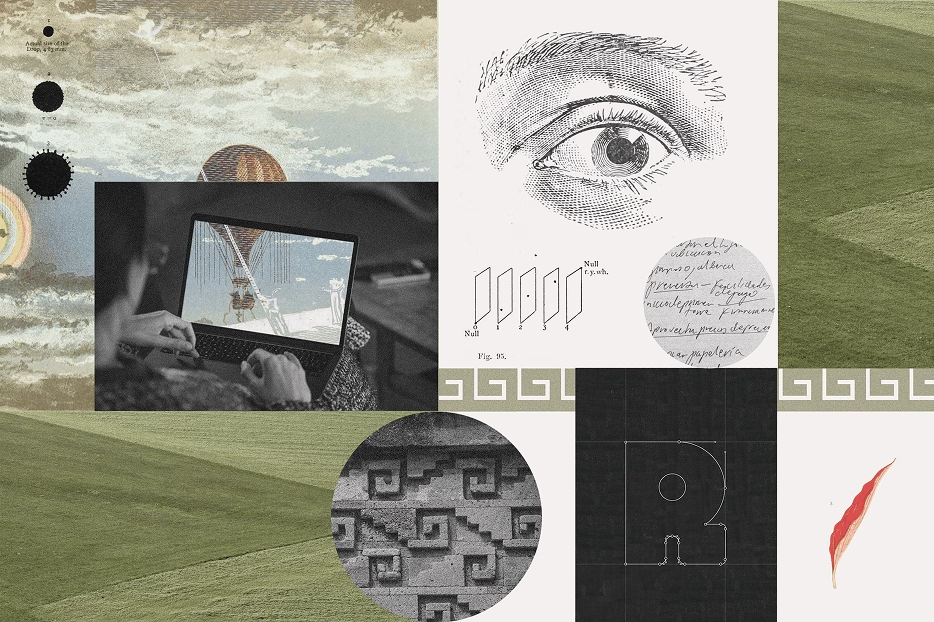
The Moodboard as Visual Thinking
The term moodboard was recorded in the early twentieth century, but the practice is far older. For decades, creatives have gathered images, materials, and common objects to capture a personality, intuition, or aesthetic direction.
But moodboards are not a final work. They are a hypothesis: a preliminary territory where ideas collide, create tension, and begin to take shape.
At its core, they externalize thought, taking what does not exist and making it visible. The power of the image lies in its polysemy: visual narratives that transcend language and cultural barriers.
The Problem: Saturation and Immediacy
Algorithms have distorted our relationship with images. Social media has amplified our role as creators and curators, but has also generated a relentless flow of visuals increasingly detached from any clear or lasting purpose.
Before personal computers became the norm (let alone smartphones), making a moodboard meant exposing yourself to worlds beyond your immediate surroundings. Visiting a museum, wandering through a market, leafing through magazines, exploring libraries: the search itself welcomed encounters with stories seemingly unrelated to the main subject.
There was editorial mediation and above all, a context that accompanied every extracted image. Today, many images live in isolation within the infinite scroll, optimized for immediate impact but disconnected from original intent.
Moodboards and Branding: the Difference Between Inspiring and Duplicating
In branding, a moodboard is a preliminary declaration of intent. It functions as a conceptual map that anticipates how a brand might look and feel.
When we use images without understanding their temporal and cultural context, we lose layers of meaning. Working solely from the surface invites naive interpretations and careless replicas. The growing number of campaigns called out for appropriation or plagiarism is the symptom of a culture that consumes visual content without reflecting on its origin, function, or symbolic weight.
When we design brands, we are in dialogue with history, economy, and identity. If we ignore these dimensions and limit ourselves to assembling trends, the result will be an identity that looks contemporary but lacks depth.
The key question is no longer “Does it look good?” but “What is it saying, and from where is it coming from?”
Time as Raw Material
The digital ecosystem has accelerated everything. Platforms like Pinterest or Instagram offer limitless inspiration but also reinforce a logic of immediacy.
Yet in a branding process, time is essential for unexpected connections to emerge. Creativity often surfaces through local references, historical archives, or disciplines far removed from design.
When a moodboard is built solely through the algorithm, the brand ends up resembling what already exists. When it is built through research and curiosity, it begins to resemble itself.
The Solution: Returning to Intention
Making a moodboard with intention means:
- Understanding the context of your references.
- Looking at everyday life and grasping where the brand will actually live.
- Recognizing what you are reinterpreting and from what position you are doing so.
- Establishing your own criteria, prioritizing meaning over trend.
Thinking about context forces us to step outside the world of design and undertake independent research. It turns us into curators in the most literal sense: guardians of a collection, responsible for how its parts relate to one another and for the narrative they build together.
It also means understanding time as an active element. Even if it seems like “everything has already been said,” statements shift when the historical moment from which they are made shifts. References acquire new meanings when placed within different cultural, political, or personal contexts.
In a world overflowing with stimuli, intention is an almost subversive act. It means halting our doomscrolling habits, leaning into history, and taking responsibility for what we choose to show and create.
Authors: Ale Baragiotta, Angel Gómez, Carolina Ortiz, Ana Rosenzweig, Osvaldo Vazquez