Work With Your Client, Not For Your Client
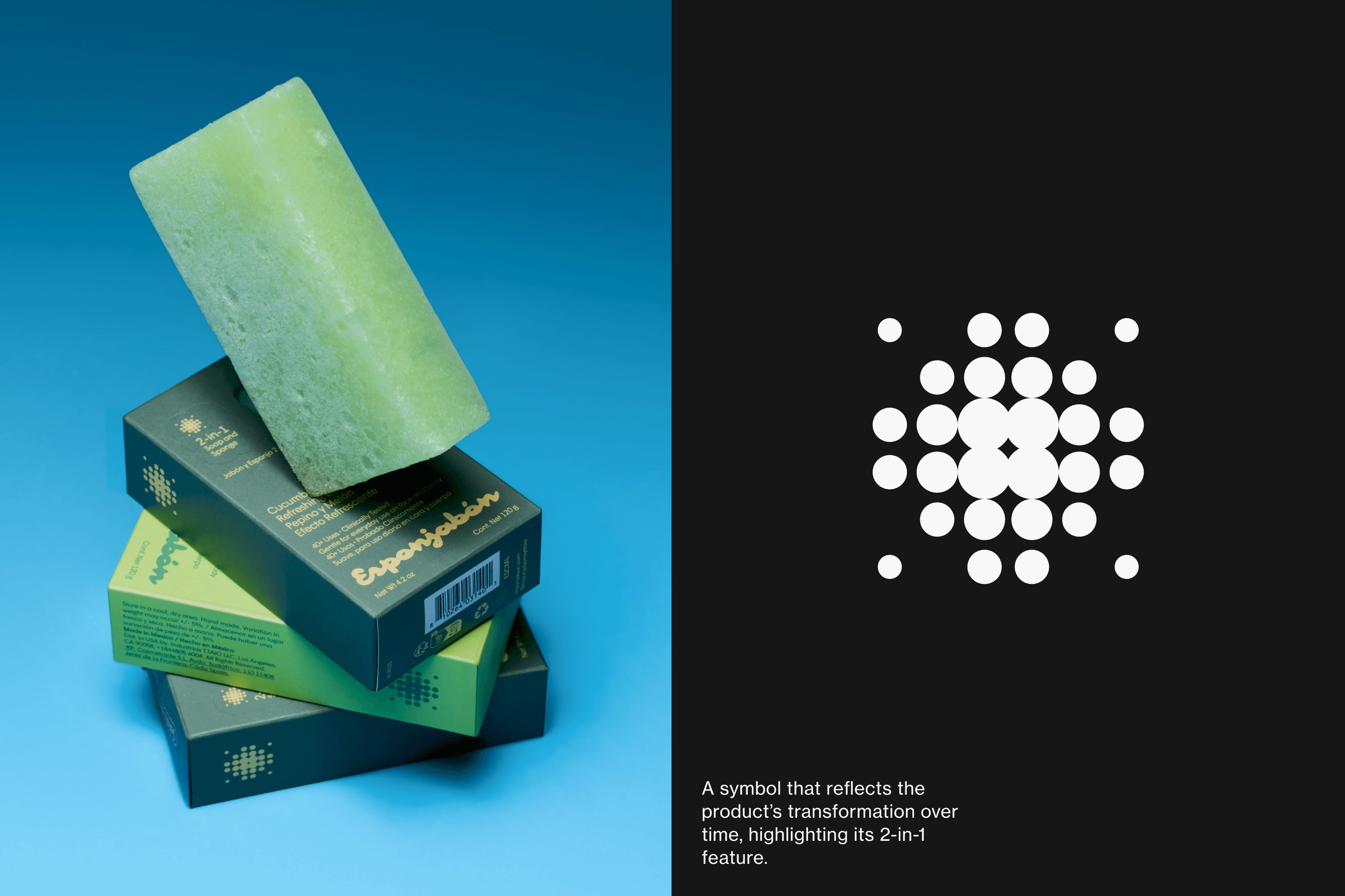
With 25 years as an established household name, Esponjabon’s variety of soap-infused sponges redefined the traditional household cleaning object with a simple, yet effective, display of Mexican ingenuity. So, as a studio based in Mexico, there’s no surprise as to the excitement we felt knowing we were tasked with reinventing their image.
As eager artists ready to tackle the “how?” aspect, we first had to consider the “why?” The challenge was clear amidst this ever-growing sea of consumer products: we had to make sure that Esponjabón was ready to be loved, now by worldwide audiences, while still maintaining its current memorable essence.
Frequent meetings played a key role in moving forward; in today’s digital landscape and acceleration of daily life, most deem meetings unnecessary. While valid, the power of real-time, unfiltered communication is essential to understand them (and the project) deeper.
Having defined that, now we move on to the “how,” right? Yes and no. The next step in the process is asking a bunch more “why?” to ensure we move with purpose.
Don’t Skip the Research
The inner curiosity in us groans at the thought of analysis: it demands play, not homework. But what good is a game you don’t understand? Think of this portion as learning chess: you need to identify what your pieces can do, the moves of your competition, and as you see where everything is, you strategize.
Getting to know who we are is where we establish brand pillars; these are the main virtues and differentiators, our north star. For Esponjabón, we knew accessibility, functionality, and innovation were these great pillars.
Once established, understanding who we’re up against is where most of the analysis portion lies and reveals aspects of the industry that might not be initially clear. For most of our projects, we divide them up into three categories: direct competition, indirect competition, and case studies. This is to comprehend what’s going on in the immediate market, foreign grounds, and unrelated brands that hold potential for what could be explored in terms of color, tone of voice, logos, and just about anything of importance for the branding process.
With the basic understanding of everything, we establish key elements. These are the results obtained from the investigation, creative recommendations developed by us, and our criteria in order to set up with certainty how it is we will be moving forward. It’s important to mention that these do not limit the next processes but can be expanded, such as a memorable logo, recognizable packaging, and a distinct photography style.
Build Worlds Meant for Exploring
When most people hear the word “moodboards,” they think visuals, a culmination of elements that paint a clearer picture of what could be. What lies within is world-building, telling a story that allows us to resonate on a level in which its significance is limited only to the extent of our imagination.
Parting from the key elements, we first write down what we wish to convey in 2-3 creative paths and ensure they can always be traced back to the brand pillars. Having common branding elements such as type, logo, and color is for grounding our moodboards in place and giving the client a clearer sense of the final product. Having said that, we must not limit ourselves to a singular source of finding inspiration. As long as it adds value to the message, it can even be in the form of an interesting flyer at your local supermarket.
Going back to Esponjabón, understanding how the practicality of the sponge could spark creativity became an important aspect we wanted to convey in two separate moodboards. Both directions were heavily influenced by concepts like movement and fluidity, connection, and, most importantly, change.
Once a path is chosen, we move on to making it all come to life.
Tell a Compelling Story
When the time finally comes to put it all together, one can’t help but wonder how this process would be without the previous. Compare the moment when you first thought of some ideas for the project: it was in the abstract world, momentarily grasping onto fleeting ideas. Whereas now the picture has emotion, language, purpose, and direction.
Learning about Esponjabón’s expansion to international markets made it clear that the 2-in-1 feature had to be front and center for accessibility. Talking to the client about the cultural importance of the product guided the rounded ends in a wordmark that calls back to its original identity. Understanding the properties of each sponge’s active ingredients and its target audience filled in the blanks for a vivid and contrasting color palette. A great story is one that keeps the audience engaged when you can retrace points back to an origin and have them make sense in the grand scheme of it all.
Conclusion
So, was this rebrand successful?
The answer lies not in a singular moment of revelation but in the sum of every decision rooted in understanding rather than assumption. By working alongside the client, honoring the research, and building a visual language that told their story, we preserved what made them beloved while preparing them for the world stage. Success in rebranding is about respecting the journey enough to let it guide you toward something that feels both familiar and entirely new. And in the end, when Esponjabón’s identity could travel across borders while still feeling unmistakably itself, we knew the work had done what it was meant to do.
Authors: Angel Gómez, Ale Baragiotta, Carolina Ortiz, Ana Rosenzweig